Procurement & the Commercial Architecture of Modern Media Organisations
Media is the largest growth lever on the balance sheet, yet most brands still struggle to prove its impact. Jack Shearring, Head of Transformation at mediasense, suggests the solution lies not in restructuring alone, but in procurement-led commercial architecture that aligns incentives, measurement and capability.
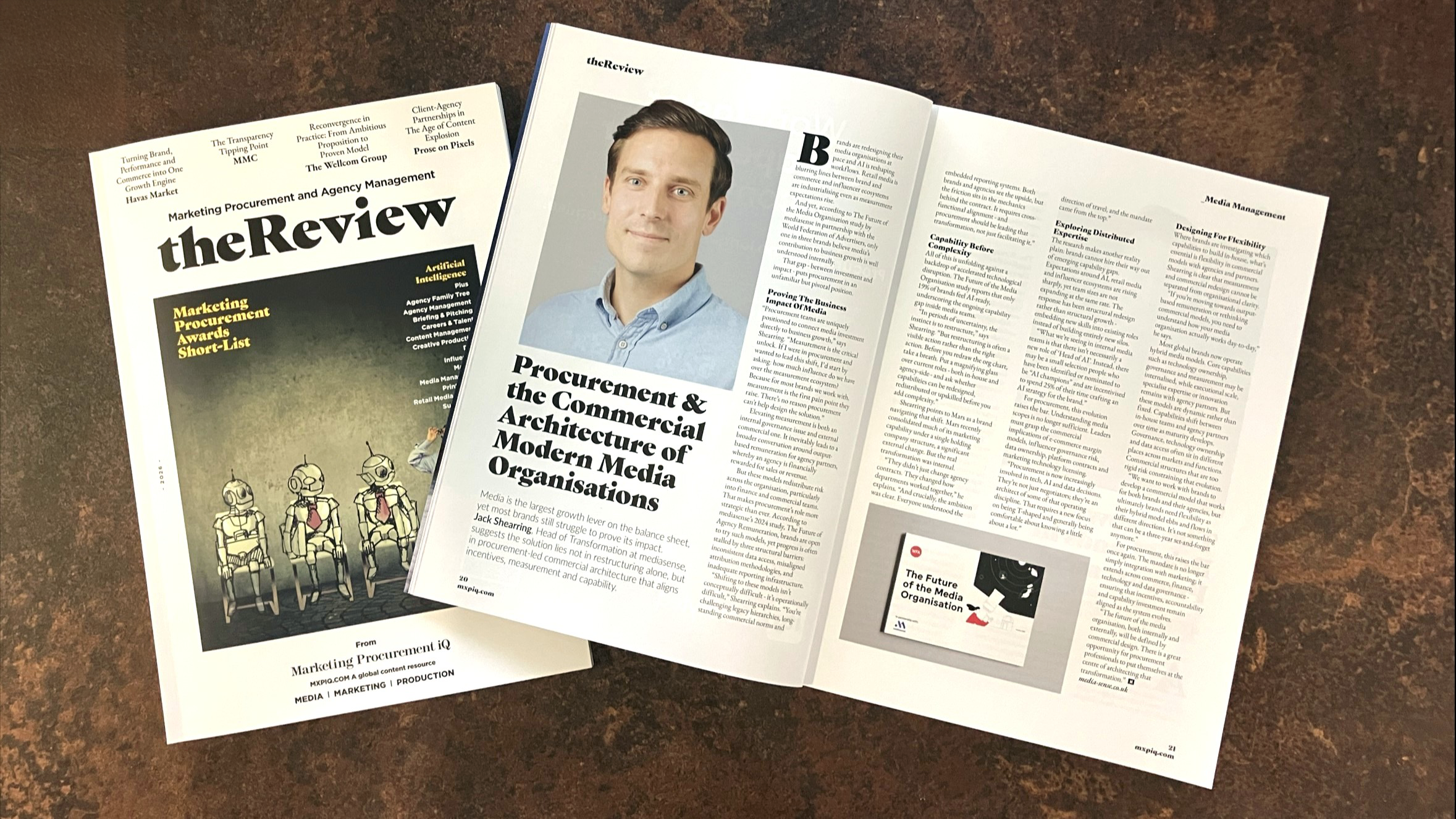
Brands are redesigning their media organisations at pace and AI is reshaping workflows. Retail media is blurring lines between brand and commerce and influencer ecosystems are industrialising even as measurement expectations rise. And yet, according to The Future of the Media Organisation study by mediasense in partnership with the World Federation of Advertisers, only one in three brands believe media’s contribution to business growth is well understood internally.
That gap – between investment and impact – puts procurement in an unfamiliar but pivotal position.
Proving the business impact of media
“Procurement teams are uniquely positioned to connect media investment directly to business growth,” says Shearring. “Measurement is the critical unlock. If I were in procurement and wanted to lead this shift, I’d start by asking: how much influence do we have over the measurement ecosystem? Because for most brands we work with, measurement is the first pain point they raise. There’s no reason procurement can’t help design the solution.”
Elevating measurement is both an internal governance issue and external commercial one. It inevitably leads to a broader conversation around output-based remuneration for agency partners, whereby an agency is financially rewarded for sales or revenue.
But these models redistribute risk across the organisation, particularly into finance and commercial teams. That makes procurement’s role more strategic than ever. According to mediasense’s 2024 study, The Future of Agency Remuneration, brands are open to try such models, yet progress is often stalled by three structural barriers: inconsistent data access, misaligned attribution methodologies, and inadequate reporting infrastructure.
“Shifting to these models isn’t conceptually difficult – it’s operationally difficult,” Shearring explains. “You’re challenging legacy hierarchies, long-standing commercial norms and embedded reporting systems. Both brands and agencies see the upside, but the friction sits in the mechanics behind the contract. It requires cross-functional alignment – and procurement should be leading that transformation, not just facilitating it.”
Capability before complexity
All of this is unfolding against a backdrop of accelerated technological disruption. The Future of the Media Organisation study reports that only 19% of brands feel AI-ready, underscoring the ongoing capability gap inside media teams.
“In periods of uncertainty, the instinct is to restructure,” says Shearring. “But restructuring is often a visible action rather than the right action. Before you redraw the org chart, take a breath. Put a magnifying glass over current roles – both in-house and agency-side – and ask whether capabilities can be redesigned, redistributed or upskilled before you add complexity.”
Shearring points to Mars as a brand navigating that shift. Mars recently consolidated much of its marketing capability under a single holding company structure, a significant external change. But the real transformation was internal.
“They didn’t just change agency contracts. They changed how departments worked together,” he explains. “And crucially, the ambition was clear. Everyone understood the direction of travel, and the mandate came from the top.”
Exploring distributed expertise
The research makes another reality plain: brands cannot hire their way out of emerging capability gaps. Expectations around AI, retail media and influencer ecosystems are rising sharply, yet team sizes are not expanding at the same rate. The response has been structural redesign rather than structural growth – embedding new skills into existing roles instead of building entirely new silos.
“What we’re seeing in internal media teams is that there isn’t necessarily a new role of ‘Head of AI’. Instead, there may be a small selection people who have been identified or nominated to be “AI champions” and are incentivised to spend 25% of their time crafting an AI strategy for the brand.”
For procurement, this evolution raises the bar. Understanding media scopes is no longer sufficient. Leaders must grasp the commercial implications of e-commerce margin models, influencer governance risk, data ownership, platform contracts and marketing technology licensing.
“Procurement is now increasingly involved in tech, AI and data decisions. They’re not just negotiators; they’re an architect of some of that operating discipline. That requires a new focus on being T-shaped and generally being comfortable about knowing a little about a lot.”
Designing for flexibility
Where brands are investigating which capabilities to build in-house, what’s essential is flexibility in commercial models with agencies and partners. Shearring is clear that measurement and commercial redesign cannot be separated from organisational clarity.
“If you’re moving towards output-based remuneration or rethinking commercial models, you need to understand how your media organisation actually works day-to-day,” he says.
Most global brands now operate hybrid media models. Core capabilities such as technology ownership, governance and measurement may be internalised, while executional scale, specialist expertise or innovation remains with agency partners. But these models are dynamic rather than fixed. Capabilities shift between in-house teams and agency partners over time as maturity develops. Governance, technology ownership and data access often sit in different places across markets and functions. Commercial structures that are too rigid risk constraining that evolution.
“We want to work with brands to develop a commercial model that works for both brands and their agencies, but ultimately brands need flexibility as their hybrid model ebbs and flows in different directions. It’s not something that can be a three-year set-and-forget anymore.”
For procurement, this raises the bar once again. The mandate is no longer simply integration with marketing; it extends across commerce, finance, technology and data governance – ensuring that incentives, accountability and capability investment remain aligned as the system evolves.
“The future of the media organisation, both internally and externally, will be defined by commercial design. There is a great opportunity for procurement professionals to put themselves at the centre of architecting that transformation.”
Get access to the thinking that shapes tomorrow’s marketing
Up next
MPiQ Talk: Making sense of the data torrent to drive media effectiveness
Marketers are facing the challenge of proving which data actually drives incremental media performance and commercial value.
mediasense Appoints Michelle Kelly as President, North America to Accelerate Unified Marketing Intelligence for Global Brands
Michelle will lead mediasense’s regional growth and help expand its advisory services across marketing ecosystem strategy, agency partnerships, operating model transformation and marketing intelligence capabilities.
Taking on the Sahara: Supporting Media Trust Through an Extraordinary Challenge
This April, our Chief Client Officer, Sam Tomlinson, is taking on an extraordinary challenge: running 250km across the Sahara Desert to raise funds for Media Trust.